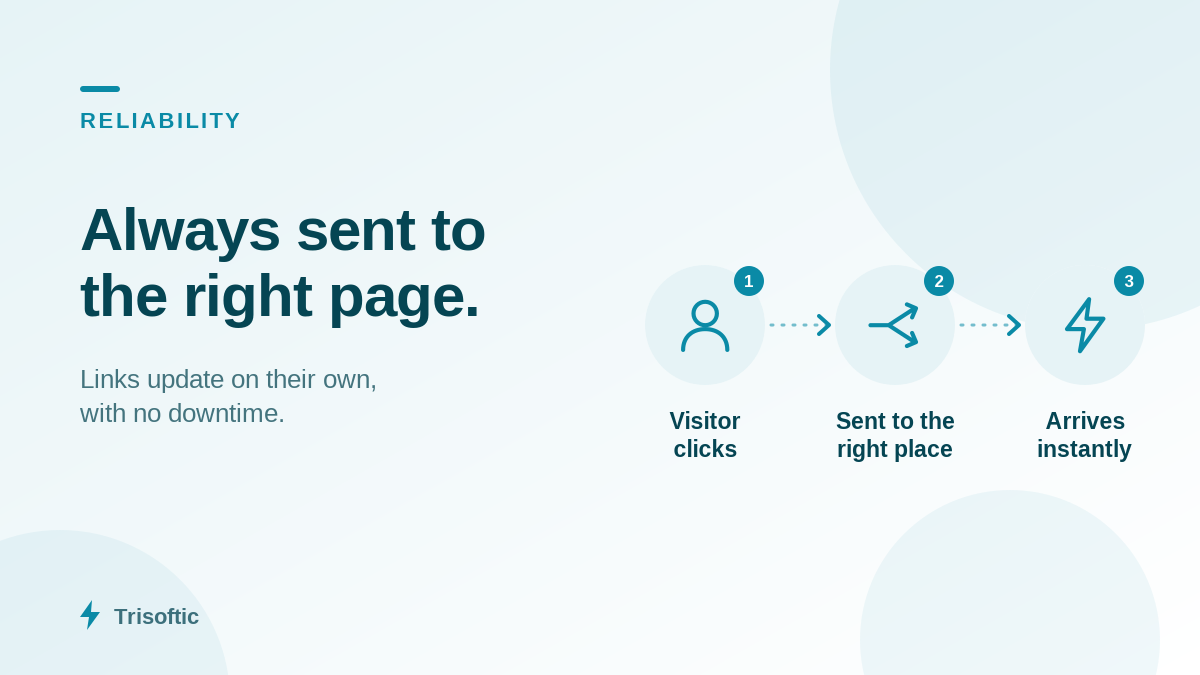
The Redirection Service project involved developing a sophisticated dynamic URL redirection system that enables real-time updates and high-performance routing for the client's educational platform. The system architecture combines Node.js services, Redis caching, Traefik reverse proxy, and AWS Lambda functions to create a robust, scalable redirection solution that automatically updates routing rules without manual intervention.
The challenge
The client needed a dynamic redirection system that could handle real-time updates to URL mappings while maintaining high performance and reliability. The challenge included building a system that could automatically propagate changes across multiple services, ensure low-latency routing, handle high traffic volumes, and provide seamless integration with existing infrastructure while maintaining zero-downtime deployments.
What we built
Developed a comprehensive redirection system using Node.js for the core service that fetches redirection mappings from SQL Server and caches them in Redis (AWS ElastiCache) for quick access. Implemented Traefik as a reverse proxy that uses Redis as its dynamic provider to handle redirection rules. Created AWS Lambda functions, configured via Serverless Framework, that trigger updates to Redis whenever mappings change, ensuring real-time propagation of routing changes.
The result
Successfully delivered a dynamic redirection system that provides real-time updates with sub-second response times. The system now handles thousands of redirection requests per second, automatically propagates changes across all services, and maintains 99.9% uptime. The solution has significantly improved user experience by reducing redirect latency and eliminating manual intervention for routing updates.
Key features
- Dynamic URL redirection system
- Real-time mapping updates
- High-performance Redis caching
- Traefik reverse proxy integration
- AWS Lambda serverless functions
- Automated CI/CD pipeline
Outcomes
- Sub-second response times
- Real-time routing updates
- Zero-downtime deployments
- High availability and reliability
- Automated infrastructure management
- Scalable and maintainable architecture